Germany's High Sea Fleet in the World War by Admiral Reinhard Scheer
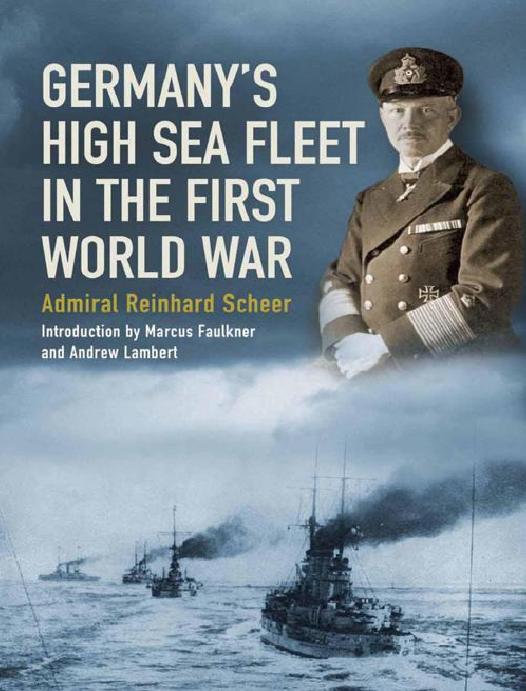
Author:Admiral Reinhard Scheer
Language: eng
Format: mobi, pdf
Publisher: Frontline Books
Published: 2014-04-30T07:00:00+00:00
CHAPTER XII
AIRSHIP ATTACKS
ON the outbreak of war the Navy had at its disposal only three airships, “L 3,” “L 4” and “L 5,” of 15,000 cb.m. capacity. The last Zeppelin built during the war bore the number “L 71,” and its capacity was 62,000 cb.m. These figures express the gigantic development which the airships underwent. The airships placed at the service of the Fleet were almost all of the Zeppelin type. The firm of Schütt-Lanz built a few ships as well, which at first were only used experimentally, but subsequently were put to practical use.
Probably no arm of any service has suffered such severe losses as our airships, with the exception of the U-boats. Out of 61 Zeppelins which were assigned to the Fleet in the course of the war, 17, with their whole crews, were destroyed by the enemy, namely “L” 7, 10, 19, 21, 22, 23, 31, 32, 34, 39, 43, 44, 48, 53, 59, 62 and 70.
Twenty-eight airships were lost through stranding and other accidents, such as the burning of sheds in consequence of explosion. The crews of these were all saved, though in six instances they were made prisoner. Six ships had to be placed out of service as being useless; at the end, ten were still left in a condition fit for use.
Owing to the ever-increasing defensive measures of the enemy the airships at the front were built in two sizes, the types being “L 50” and “L 70.”
The chief distinctive features of the former were five motors, each of 260 h.p., and such as could develop sufficient speed even in the highly rarefied atmosphere of the upper strata of the air; four propellers, all coupled directly to the shafts (the two rear motors are coupled to one propeller); a central gangway, 196.5 m. long; a breadth of 239 m.; a gas capacity of 55,000 cb.m.; a speed of 30 metres per second (about no km. per hour); a load of 38 tons.
Type “L 70”: Seven motors, each of 260 h.p.; six propellers; central gangway, 211.5 m.; greatest diameter, 239 m.; volume of gas, 62,000 cb.m.; speed, 35 metres per second (equal to 130 km. per hour); load, 43 tons.
The “L 50” carried a crew of 21, and “L 70” one of 25, among whom were 1 Commander, 1 Officer of the Watch, 1 Quarter-Master, 1 Chief Artificer-Engineer, 2 men for lifting gear (Yeomen of Signals,) 2 men for the balancing gear (Boatswains), 2 Motormen (stoker petty officers) for each motor, 1 Sailmaker, 1 Petty Officer Telegraphist, and 1 Ordinary Telegraphist for the wireless installation.
They carried two machine-guns, and later on a 2-cm. gun as well. The supply of bombs consisted of incendiary bombs of 11.4 kilo weight, and explosive bombs of 50, 100, and 300 kilos.
In order to gain some idea of the difficulties encountered by airships, it may not be out of place to make a few general remarks on the navigation of these ships.
Their main task was scouting. That is why they were retained during the war as a weapon by the Navy; the Army had no use for them.
Download
Germany's High Sea Fleet in the World War by Admiral Reinhard Scheer.pdf
This site does not store any files on its server. We only index and link to content provided by other sites. Please contact the content providers to delete copyright contents if any and email us, we'll remove relevant links or contents immediately.
The Radium Girls by Kate Moore(12028)
100 Deadly Skills by Clint Emerson(4924)
Rise and Kill First by Ronen Bergman(4788)
The Templars by Dan Jones(4689)
The Doomsday Machine by Daniel Ellsberg(4490)
The Rape of Nanking by Iris Chang(4211)
Killing England by Bill O'Reilly(4001)
Stalin by Stephen Kotkin(3965)
Hitler in Los Angeles by Steven J. Ross(3946)
12 Strong by Doug Stanton(3549)
Hitler's Monsters by Eric Kurlander(3341)
Blood and Sand by Alex Von Tunzelmann(3203)
The Code Book by Simon Singh(3189)
Darkest Hour by Anthony McCarten(3129)
The Art of War Visualized by Jessica Hagy(3007)
Hitler's Flying Saucers: A Guide to German Flying Discs of the Second World War by Stevens Henry(2754)
Babylon's Ark by Lawrence Anthony(2677)
The Second World Wars by Victor Davis Hanson(2524)
Tobruk by Peter Fitzsimons(2516)
